
What Is Python Programming?
Python is a high-level, general-purpose programming language known for its readable
syntax and large collection of libraries and frameworks.
Python can be used for many different types of development, including:
- Web development
- Software development
- Automation
- Data analysis
- Artificial intelligence
- Machine learning
- Web scraping
- API development
- Database applications
- Testing and scripting
Because Python can be used across different technology domains, learning its fundamentals
can provide a strong base for exploring different programming careers and projects.
Why Learn Python?
One of the main advantages of Python is its relatively simple and readable syntax.
Beginners can focus on programming concepts without dealing with excessive syntax complexity.
Python is also supported by a large ecosystem of libraries and frameworks. Developers
can use existing tools instead of building every feature from scratch.
Learning Python can help you understand:
- Programming fundamentals
- Problem-solving techniques
- Object-oriented programming
- File handling
- Database connectivity
- API development
- Automation
- Data processing
- Web development
- AI and machine learning concepts
Python is also widely used in educational environments, startups, technology companies,
research, and business applications.
What Will You Learn in a Python Programming Course?
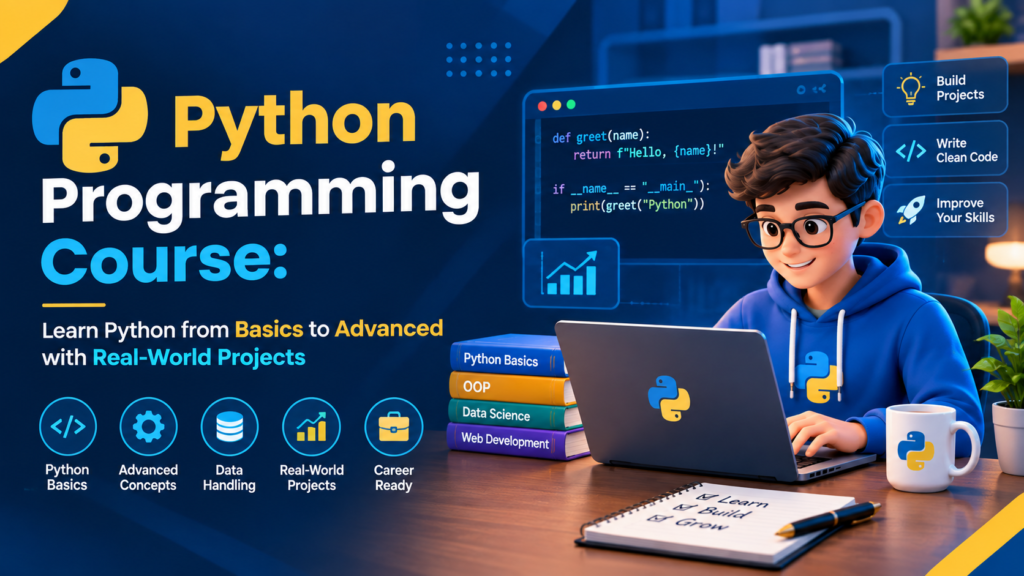
A practical Python course can take learners from basic programming concepts to advanced
development techniques.
1. Python Fundamentals
The first stage focuses on understanding the basics of programming and Python syntax.
Students can learn:
- Variables
- Data types
- Operators
- Input and output
- Comments
- Conditional statements
- Loops
- Basic error handling
For example, learners can start by writing small programs and gradually solve more
complex programming problems.
Understanding these fundamentals is important because advanced Python development
depends on a strong understanding of basic programming concepts.
2. Python Data Structures
Data structures help programmers store and organize information efficiently.
Python provides several built-in data structures, including:
- Lists
- Tuples
- Dictionaries
- Sets
- Strings
Learners can practice adding, updating, searching, sorting, and processing data using
these structures.
Understanding data structures is particularly useful when working with APIs, databases,
automation workflows, and data analysis.
3. Functions and Modules
Functions allow developers to organize code into reusable blocks.
A Python Programming Course can teach learners how to create functions, pass arguments,
return values, and organize larger programs.
Students can also learn how modules and packages help organize Python applications into
manageable components.
These concepts encourage cleaner and more reusable code.
Object-Oriented Programming in Python
Object-oriented programming, commonly known as OOP, is an important concept for developing
larger applications.
Python supports object-oriented programming through concepts such as:
- Classes
- Objects
- Attributes
- Methods
- Inheritance
- Encapsulation
- Polymorphism
Learning OOP can help students understand how complex software applications can be
structured into reusable components.
Practical exercises can include building small applications using classes and objects.
File Handling and Exception Handling
Real-world applications frequently need to read, write, update, and process files.
Python provides tools for working with different types of files, including text and
structured data formats.
Learners can practice:
- Reading files
- Writing files
- Updating files
- Working with CSV data
- Processing JSON data
Exception handling is another important programming concept. Students can learn how to
handle unexpected situations using Python’s error-handling mechanisms.
This helps make applications more reliable and easier to maintain.
Python Database Connectivity
Most real-world applications need to store and retrieve information.
A Python course can introduce learners to database concepts and show how Python
applications communicate with databases.
Students can learn how to:
- Connect applications to databases
- Create and retrieve records
- Update data
- Delete records
- Execute queries
- Work with structured application data
Database knowledge can be useful for web applications, business software, automation
systems, and data-driven projects.
Python for Web Development
Python is widely used for backend and web application development. Frameworks such as
Django and Flask can help developers create web applications, APIs, and backend services.
A practical course may introduce concepts such as:
- Backend development
- Routing
- APIs
- Forms
- Database integration
- Authentication
- Application structure
Learners can use these concepts to build projects such as websites, REST APIs, dashboards,
and business applications.
Python for Automation
Python is also a useful language for automating repetitive tasks.
Automation scripts can be created to process files, organize information, interact with
APIs, generate reports, or perform other repetitive operations.
For example, a Python script could read data from a file, process the information, and
generate an output report automatically.
Python automation can be useful in:
- Office tasks
- Data processing
- File management
- Reporting
- Web tasks
- API integrations
- Testing
Learning automation gives students an opportunity to apply programming skills to practical
problems.
Python for Data Science and AI
Python has a strong presence in data science, artificial intelligence, and machine learning.
Popular Python libraries and frameworks are used for numerical computing, data processing,
visualization, machine learning, and AI development.
Learners can gradually explore areas such as:
- Data analysis
- Data visualization
- Machine learning
- Natural language processing
- Artificial intelligence
- Generative AI
A strong understanding of Python fundamentals is helpful before moving into advanced AI
and machine learning concepts.
Real-World Python Projects
Project-based learning can help students understand how programming concepts work together.
A Python Programming Course can include projects such as:
- Calculator application
- Student management system
- Expense tracker
- To-do application
- File management automation
- Web scraping project
- Weather application using an API
- REST API project
- Database application
- Data analysis project
These projects allow learners to practice programming concepts while developing practical
problem-solving skills.
Who Should Learn Python?
Python is suitable for learners from different educational and professional backgrounds.
A Python Programming Course can be useful for:
- Students
- Beginners
- BCA students
- MCA students
- B.Tech students
- Diploma students
- Web developers
- Software professionals
- Data enthusiasts
- Automation professionals
- Freelancers
- Career switchers
Programming experience is not necessarily required for beginners. A structured course
can start with basic concepts and gradually introduce more advanced topics.
Benefits of Learning Python Through Practical Projects
Learning programming through projects can make it easier to connect theoretical concepts
with real applications.
Practical Python training can help learners:
- Improve logical thinking
- Develop problem-solving skills
- Understand programming concepts
- Build portfolio projects
- Learn application development
- Explore automation
- Work with APIs and databases
- Prepare for advanced technologies
Projects can also give learners examples of their work that may be useful when creating
a technical portfolio.
Python and the Future of Technology
Python continues to be used across many technology areas, including software development,
automation, data analysis, artificial intelligence, and machine learning.
The language itself is only one part of becoming a good programmer. Learners should also
develop problem-solving ability, debugging skills, logical thinking, code organization,
and an understanding of software development practices.
As technology evolves, these fundamental programming skills can remain useful across
different tools and frameworks.
Conclusion
A Python Programming Course can help learners build programming knowledge
from basic syntax to advanced concepts and real-world application development.
By learning Python fundamentals, data structures, functions, object-oriented programming,
databases, APIs, automation, web development, and advanced technology applications, students
can create a strong foundation for further learning.
Whether you are a beginner, student, developer, freelancer, or working professional,
Python can be a practical language to add to your technical skill set.
The most effective way to learn Python is through consistent practice and real-world projects.
By writing code regularly, solving programming problems, debugging errors, and building useful
applications, learners can gradually develop the confidence and skills required to work with
Python in different technology domains.